The EU AI Act is no longer a future regulation. It is now part of the legal landscape for businesses developing, deploying, distributing, or using artificial intelligence.
Yet many companies are still making the same mistakes.
Some assume the regulation only applies to European companies. Others believe that simply using AI tools such as ChatGPT, Claude, Gemini, Midjourney, or Copilot automatically makes them compliant.
Neither assumption is correct.
Whether your business is based in the European Union, the United States, South Korea, Singapore, Canada, or elsewhere, understanding how the EU AI Act applies is becoming increasingly important.
Here are five of the most common mistakes businesses are still making in 2026.
Mistake #1: Assuming the EU AI Act Only Applies to EU Companies
Which Businesses Does the EU AI Act Apply To?
One of the biggest misconceptions surrounding the EU AI Act is that it only affects businesses established within the European Union.
It doesn’t.
The Regulation has extraterritorial reach. Depending on how your AI system is developed, marketed, deployed, or used, the EU AI Act may also apply to businesses located outside Europe.
If your AI system is placed on the EU market or its output is used within the European Union, your business may have obligations under the Regulation even if your company operates entirely outside the EU.
For many international businesses, the better question is no longer:
“Where is my company located?”
Instead, ask: “Where is my AI being used?”
Mistake #2: Not Knowing Whether You’re a Provider or a Deployer
Am I a Provider or a Deployer Under the EU AI Act?
The obligations imposed by the EU AI Act depend largely on your role.
A business developing or placing an AI system on the market generally has different legal responsibilities from a business simply using an existing AI system.
Understanding whether you are acting as a provider, deployer, importer, distributor, or another regulated actor is one of the first steps toward compliance.
Without identifying your role correctly, it becomes difficult to understand which obligations apply to your business.
Mistake #3: Treating Every AI Tool the Same
Do All AI Systems Carry the Same Level of Risk Under the EU AI Act?
No.
The EU AI Act follows a risk-based approach.
Not every AI system carries the same legal obligations.
Certain AI practices are prohibited altogether. Others fall into the high-risk category and require extensive compliance measures. Some AI systems are subject primarily to transparency obligations, while others face limited regulatory requirements.
Businesses should first identify every AI system they use before determining which legal obligations may apply.
Assuming every AI tool is regulated in the same way is one of the fastest ways to misunderstand the Act.
Mistake #4: Ignoring Intellectual Property Risks
Can Using AI Put My Business’s Intellectual Property at Risk?
Absolutely. The EU AI Act is only one piece of the legal landscape.
Businesses using artificial intelligence should also evaluate intellectual property issues such as copyright ownership, trademarks, licensing, confidential information, trade secrets, contractual restrictions, and ownership of AI-generated outputs.
Many businesses focus exclusively on AI compliance while overlooking whether they actually own or are permitted to commercialize the content their AI systems generate.
AI governance and intellectual property strategy increasingly go hand in hand.
Mistake #5: Waiting Until Enforcement Begins
Should My Business Wait Until the EU AI Act Is Fully Enforced?
Waiting is rarely the best compliance strategy.
Preparing for the EU AI Act involves much more than reviewing legislation.
Businesses should begin identifying the AI systems they use, mapping vendors, reviewing contracts, documenting AI use cases, assigning internal responsibilities, and establishing governance processes well before enforcement becomes an issue.
Organizations that prepare early will generally be in a much stronger position than those attempting to react after compliance obligations become immediate.
- Why South Korea Needs an Independent Institute of Data Analytics

- 5 Costly EU AI Act Mistakes Businesses Are Still Making in 2026

- Is Your Brand Name Actually Protected by Copyright?
Why the EU AI Act Matters for Businesses
The EU AI Act represents more than another regulatory framework.
It reflects a broader shift toward AI governance, accountability, transparency, and responsible innovation.
For many businesses, AI compliance is becoming part of market access.
Understanding whether the Regulation applies to your organization and what practical steps should be taken can help reduce legal, contractual, operational, and reputational risks.
Need a Practical EU AI Act Compliance Guide?
To help businesses better understand these obligations, I created:
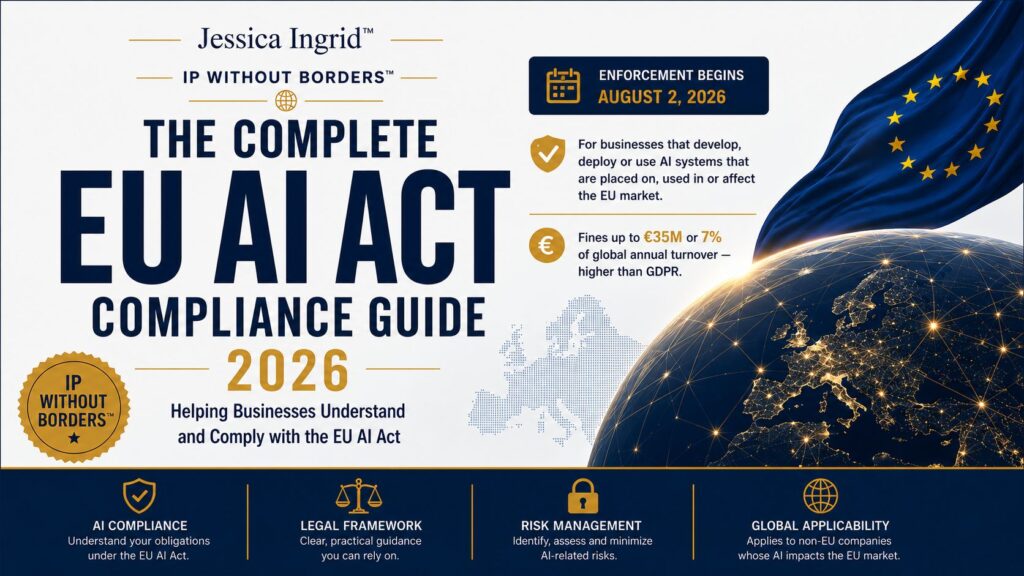
IP WITHOUT BORDERS™: The Complete EU AI Act Compliance Guide 2026
Inside the guide, you’ll find:
- Plain-English explanations of the EU AI Act
- Provider vs. Deployer guidance
- AI risk classifications
- Practical compliance checklists
- AI governance recommendations
- Intellectual property considerations
- AI System Inventory Template
- A practical 30/60/90-day compliance roadmap
- Real-world business examples
Whether you’re a startup, established business, creator, consultant, or international company serving the European market, the guide is designed to help you better understand the legal and business implications of the EU AI Act.
It is now available through my website.
Frequently Asked Questions
1. Does the EU AI Act apply to companies outside Europe?
Yes. Depending on the circumstances, the Regulation may apply to businesses located outside the European Union if their AI systems are placed on the EU market or their outputs are used within the EU.
2. What is the difference between a provider and a deployer?
A provider generally develops or places an AI system on the market, while a deployer uses an AI system within its business or professional activities. Different obligations may apply depending on your role.
3. Do all AI systems carry the same legal obligations?
No. The EU AI Act follows a risk-based framework, meaning different categories of AI systems are subject to different compliance requirements.
4. Can AI create intellectual property risks?
Yes. Businesses should consider copyright, trademarks, licensing, confidentiality, trade secrets, contractual restrictions, and ownership of AI-generated content alongside EU AI Act compliance.
5. When should businesses begin preparing for the EU AI Act?
The best time to begin is before enforcement becomes an issue. Early preparation allows businesses to identify AI systems, review contracts, establish governance processes, and address potential compliance gaps proactively.